|
Apple users running MacOSX 10.4 or later must
install Microsoft's Silverlight software in order to view the streaming videos.
Once installed, restart your browser before viewing.
Silverlight 4.0 intel (14MB) |
Silverlight 1.0 ppc (5MB)

WATCH
AND
LISTEN |
shorter |
Stefan Rahmstorf‒A Scientist's Mind, and an Artist's Eye
Peter Sinclair, Yale Climate Connections
An eloquent short film about this respected ocean and climate scientist and
how he sees the relationship between his scientific work and his passion for
photography. He says, "Science is about the rational mind, the dispassionate
and the objective, whereas, photography to me is about the passionate and the
subjective, and I couldn't feel like a whole person if I was only developing
the entirely rational part of myself."
(September 2015)
The Beauty in our Melting World
Dish
A short video (2014) about the large-scale pastel paintings of ice and water by
artist Zaria Forman, done in the context of climate change. More images on
her own website.
Also see Brian Kahn's (April 2017) Climate Central
portrait of this artist and her work.
(September 2014)
EveryDayClimateChange
Housed on
Instagram and with a good presence on
Facebook, this collection of donated professional photos documents the
actual effects of climate change on people, wildlife, and landscapes around
the world. You can read a story by Katherine Bagley of InsideClimate News
about this initiative
here.
(photos)
|
| |
longer |
Art and Science: Time Lapse Proof of Extreme Ice Loss
James Balog
Excellent short Ted Talk by photographer James Balog, who speaks here of the
importance of combining science with art, and who shows and comments on some
of his jaw-dropping time-lapse footage of retreating glaciers in several parts
of the world, with vivid illustrations of the scale of these changes.
(20 minutes, 2009)
Climate Change and the Literary Imagination: Poetry *
Linda Bierds, Department of English,
University of Washington
Linda Bierds, a major poet who has long been interested in science and has
become concerned about climate change, speaks here of what inspires her,
describes her research methods, and reads several poems.
(25 minutes, November 2008)
Climate Change and the Literary Imagination: Creative Nonfiction *
Marybeth Holleman, Anchorage, Alaska
What do writers and artists do when they tackle the topic of climate change?
In this talk and reading, writer Holleman addresses this question by focusing
on what's happening to polar bears as the Far North warms: the facts, yes, but
also the way their stories make us feel and challenge the ways we make sense
of our world.
(25 minutes, November 2008)
|
| READ |
books |
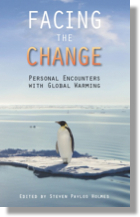 Facing the Change: Personal Encounters with Global Warming
Steven Pavlos Holmes, editor, Torrey House Press 2013, 161pp
This thought- and emotion-provoking collection offers poems and personal
essays about climate change by 38 writers: their experiences, feelings, and
attempts to make meaning of the changes we're facing. As the editor notes,
these pieces are not about scientific or political debates but about "human
stories" and "poetic imagination"; reading them is a little like having a
series of intimate (and sometimes uncomfortable) conversations.
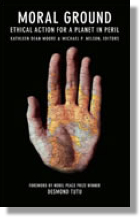 Moral Ground: Ethical Action for a Planet in
Peril
Moral Ground: Ethical Action for a Planet in
Peril
Kathleen Dean Moore & Michael P. Nelson, editors. Trinity
University Press, 2010, 464 pp.
This compelling collection offers some 80 short essays by theologians,
religious leaders, philosophers, naturalists, scientists, elected officials,
business leaders, activists, and writers, each addressing the critical
question, "Do we have a moral obligation to future generations, to leave them
a world as rich in life and possibility as the world we inherited?" Making a
wide range of ethical arguments, in voices from many standpoints and many
places, including all the continents except Antarctica, these thinkers all
answer yes, explain why they believe this, and suggest steps we can
take‒in words that are eloquent, pointed, clear, and often beautiful.
Click here for more
information on the book.
|
| |
articles & essays |
Raising My Child in a Doomed World
Roy Scranton, New York Times, July 2018
If you are convinced that we are heading for major trouble with climate
change, how can you think about having and raising a child? This powerful
writer of personal essays faces this tough question with clarity, compassion,
and eloquence.
"Our Melting, Shifting, Liquid World"; Celebrities Read Poems on Climate Change
The Guardian, November 2015
It is hard to find climate-change poetry online, but this is a good starting
collection of 21 poems on this general subject, some more obviously linked
than others, all read by actors. Curated by the poet laureate of the U.K.,
Carol Ann Duffy.
Amazing Art Makes Climate Change Conceivable
World Science Festival, 2015
A small but good selection of art projects dealing with climate change, with
links to the artists' own websites.
Our Polar Regions Are Simply 'Melting Away,' and It's a Beautiful Disaster
Interview by James Gerken of Camille Seaman, Huffington Post, January 2015
A sampling of the gripping images from photographer Camille Seaman's book
Melting Away: A Ten-Year Journey through our Endangered Polar Regions,
along with a brief interview with the artist.
Climate Change Has Created a New Literary Genre
Daniel Bloom, Washington Post, July 2014
A good quick introduction to climate-change fiction‒cli-fi‒with some titles
for getting started. For a brief but provocative caution, see George
Marshall's brief note,
"Climate Fiction Will Reinforce Existing Views."
Taking the World By Storm? Weather Inspired Music
Edward Ortiz, San Francisco Classical Voice, July 2013
Weather and climate (and wildfires, melting ice, hurricanes, heat, cold,
politics): what do they have to do with musical composition and performance?
This article explores this interesting question, partly through a study done
by two musical scientists of historical links between weather and classical
music and partly through several contemporary composers concerned with climate
change, including Brett Dean and John Luther Adams.
Scenes from a Melting Planet: On the Climate Change Novel
Carolyn Kormann, The New Yorker blog, July 2013
Good short piece about the current state of novels and short fiction that take
climate change seriously, with this telling line: "Today, novels that would
once have been called science fiction can be read as social realism." Ideas
for what to read, plus a call to fiction writers.
|
| |
websites |
Arctic Series Photographs
Subhankar Banerjee, 2000-
This photographer has worked in the arctic for over a decade now, capturing
images and writing about the effects of climate change and other stresses on
animals and people. The images are very strong, as is much of the writing. His
website offers samples. His first book, Arctic National Wildlife Refuge:
Seasons of Life and Land (2003), is excellent.
World View of Global Warming
Gary Braasch
This accomplished photographer/journalist has given his attention to climate
change for quite a while now, and his archive of photos and commentary is well
worth studying. In 2016, he died photographing the bleaching event on
Australia’s Great Barrier Reef.
Change as Art
A compilation of "artists, art organizations, and art works that address
social and environmental issues by making measureable change." Not just about
climate change, but many of the pieces represented here do deal with this
topic.
Artists and Climate Change
A comprehensive collection of annotated links to arts groups that address
climate change. The
related
blog features strong artistic responses (of many types) that help
translate scientific facts into human emotions and food for reflection. It is
"both a study of what is being done, and a resource for anyone interested in
the subject."
ClimateChangeEducation.org: Visual Arts
An extensive and very good collection of links to visual arts dealing with
"climate change and global warming solutions," including artists, galleries,
organizations, exhibits, books, and contests. Usefully divided into categories
such as sculpture, painting, photography, fashion, graphic arts, and so on.
The larger site of which this is a part focuses on K-12 education on climate
change and offers additional useful links to such things as movies,
television, and museums.
Extreme Ice Survey and Chasing Ice (film)
In his Extreme Ice Survey, photographer James Balog is creating a stunning
array of still, time-lapse, and video images of glaciers around the world.
Enacting the motto "Seeing is Believing," Balog and his team invite visitors
to the project's excellent website to see for themselves both what is
happening to glaciers today and what kinds of beauty they give to our world.
This work brings together the powers of art and of science to illuminate our
situation and urge action. The award-winning film about Balog and this
project, directed by Jeff Orlowski, is very powerful. Lasting about 75
minutes, it is now available on iTunes and Netflix and the DVD costs just $20.
Cape Farewell Project
Led by artist David Buckland, this London-based project sponsors
creative cultural responses to climate change, taking visual artists,
writers, and young people on expeditions to the arctic and creating art
exhibitions and performances. In their words: "Using creativity to innovate,
we engage artists for their ability to evolve and amplify a creative language,
communicating on a human scale the urgency of the global climate challenge."
Their website offers expedition blogs, images, and more.
|
| TEACH |
resources |
Teaching Climate Change in Language & Literature Classes
SueEllen Campbell, Colorado State University English Dept. and Changing Climates @ CSU, Summer 2015
Here are some of the materials from workshops held at two meetings: WLA, the
Western Literature Association (fall 2014) and ASLE, the Association for the
Study of Literature and Environment (summer 2015), including the workshop
leader's
talking slides (without
images for quicker downloading), some useful scientific
graphs and maps, a
short list of resources that
might be especially useful in such courses, one sample handout on
what we can do, and‒NOT
LEAST!‒selections from the
participants'
contributions to the ASLE workshop.
Writing Arguments: Spaceship Earth assignment
Tom Conway, Colorado State University
For an advanced composition class focused on argumentation, Conway asks
students to imagine, research, and argue for some specific element of a
spaceship designed to take a city-sized group into space for 150 years with
sustainability and flourishing in mind, then think about how their plans could
work on our actual planet.
|
|
|