|
* Apple users running MacOSX 10.4 or later must
install Microsoft's Silverlight software in order to view the streaming videos marked with *.
Once installed, restart your browser before viewing.
Silverlight 4.0 intel (14MB) |
Silverlight 1.0 ppc (5MB)

WATCH
AND
LISTEN |
under 10 minutes |
Brother Sun, Sister Moon: Pope Francis and the Meaning of Climate Action
Peter Sinclair, Yale Climate Connections
What does the Christian tradition have to say about our responsibility to
Earth and its creatures? Plenty. Here is a short, multi-denominational answer.
(7 minutes, June 2015)
Climate Change: A Moral Crisis
low-res stream |
med-res stream |
QuickTime movie
Kathleen Dean Moore, Department of Philosophy, Oregon
State University
"Do we have a moral obligation to the future, to leave a world as rich in
possibilities as our own?" Dr. Moore‒philosopher, ethicist, essayist,
and co-editor of Moral Ground: Ethical Action for a Planet in Peril
‒offers a compelling array of answers given by fellow citizens.
(7 minutes, April 2010)
|
| |
longer |
Climate Change: Faith and Fact
Bill Moyers and Katherine Hayhoe, Moyers & Company
A terrific interview with climate scientist and evangelical Christian
Katherine Hayhoe, perhaps the clearest, most eloquent, and best-informed voice
making the case that Christians (and, by extension, many other religious
people) should care deeply about this issue‒and act. Moyers, who has a
long history of paying serious attention to matters of faith, is one of the
best interviewers around, and he asks excellent and wide-ranging questions.
(25 minutes, September 2014)
Moral Reasoning for Climate Scientists
Kathleen Dean Moore and Michael P. Nelson, Oregon State University
In this lucid, friendly talk, leading environmental philosophers Moore and
Nelson offer logical and ethical tools and arguments for thinking and talking
about climate change; subtopics include addressing denial, combatting
hopelessness, and advocating for scientists.
(40 minutes, 2013)
|
| READ |
books |
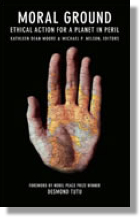 Moral Ground: Ethical Action for a Planet in
Peril
Moral Ground: Ethical Action for a Planet in
Peril
Kathleen Dean Moore & Michael P. Nelson, editors. Trinity
University Press, 2010, 464 pp.
This compelling collection offers some 80 short essays by theologians,
religious leaders, philosophers, naturalists, scientists, elected officials,
business leaders, activists, and writers, each addressing the critical
question, "Do we have a moral obligation to future generations, to leave them
a world as rich in life and possibility as the world we inherited?" Making a
wide range of ethical arguments, in voices from many standpoints and many
places, including all the continents except Antarctica, these thinkers all
answer yes, explain why they believe this, and suggest steps we can
take‒in words that are eloquent, pointed, clear, and often beautiful.
Click here for more
information on the book.
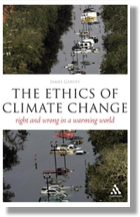 The Ethics of Climate Change: Right and Wrong in a Warming World
James Garvey, Coninuum, 2008, 158pp
A clear, readable elucidation of key ethical arguments about who should do
what about climate change‒and why. As ethicist Peter Singer says, this
short book is "a model of philosophical reasoning about one of the greatest
moral challenges any generation has ever faced."
|
| |
articles & essays |
Who is the We in "We Are Causing Climate Change"?
Genevieve Guenther, Slate, October 2018
As the subtitle to this excellent and bracing column has it, "Everyone is not
equally complicit here." We need to remember this. But we might also do well
to think of climate change as "something we are being prevented from
undoing"‒a thought that should help us place the responsibility
where it now truly lies.
Buddhist Climate Change Statement to World Leaders 2015
Global Buddhist Climate Change Collective, October 2015
Joining the chorus of religious leaders who are speaking up about global
warming, this short, direct statement "is founded on the Buddha's realization
of dependent co-arising, which interconnects all things in the universe." The
writers and signers, Buddhist leaders from all over the world (including the
Dalai Lama and Thich Nhat Hanh), note that "Cultivating the insight of
interbeing and compassion, we will be able to act out of love, not fear, to
protect our planet" and remind us that "our lives are inextricably interwoven
with the natural world through every breath we take, the water we drink, and
the food we eat."
Encyclical Letter LAUDATO SI' on Care for our Common Home
Pope Francis, Summer 2015
Opening with the words of Saint Francis of Assisi, "Praise be to you, my Lord,
through our Sister, Mother Earth, who sustains and governs us, and who
produces various fruit with coloured flowers and herbs," and then citing many
statements of his predecessors, Pope Francis's powerful letter to the world
offers a wide-ranging and eloquent meditation on how the planet's current
environmental and social justice problems, including climate change, fit into
a religious and spiritual world view. Writing that "We are called to be
instruments of God our Father so that our planet might be what he desired when
he created it and correspond with his plan for peace, beauty and fullness.
The problem is that we still lack the culture needed to confront this crisis,"
he suggests some ways we might all help develop such a culture.
Czech Republic.
Rabbinic Letter on the Climate Crisis
Summer, 2015
With over 400 rabbis signing, this letter notes that "the Divine presence
dwells within as well as beyond the world" and calls "for a new sense of
eco-social justice ‒ a tikkun olam that includes tikkun tevel, the
healing of our planet." Offering a few possible actions congregations might
take, these rabbis cite Leviticus 25-26 and Deuteronomy 15 on our
responsibility to let the earth rest from its work.
Islamic Declaration on Global Climate Change
Summer 2015
Citing passages from the Qur'an, actions of the Prophet Muhammad, and
scientific knowledge, this group of prominent Muslims (gathered at an
International Islamic Climate Change Symposium in Istanbul) reminds the
faithful that Allah created the world to be in balance, that we have upset
that balance, and that it is our responsibility to redress these problems and
work to heal the creation.
For Faithful, Social Justice Goals Demand Action on Environment
Justin Gillis, New York Times, June 2015
A characteristically good overview by this reporter on the conversation in
American religious groups about the links between climate change and social
justice, with the stories of several people of faith who have become concerned
about the heavy impacts of climate disruption on the poor.
What the Climate Movement Must Learn from Religion
George Marshall, The Guardian, April 2015
Conviction: religion knows a lot about this strong force and how it can move
us beyond guilt, fear, and despair into personal and communal action. Marshall
points out that those who wish to move others to act on climate change have
important things to learn.
The Ethical Dimension of Tackling Climate Change
Stephen Gardiner, Yale Environment 360, 2011
From the author of A Perfect Moral Storm: The Ethical Tragedy of Climate
Change, this short essay is a thought-provoking introduction to some of the
key ethical decisions involved in dealing with this problem.
The Moral Climate
Carl Safina, Orion Magazine, summer 2008
A short and powerful essay about what we're really sacrificing when we neglect
to do anything significant to stop climate change. Safina is an ecologist,
marine conservationist, and author of several books, including The View
from Lazy Point: A Natural Year in an Unnatural World, which deals in very
interesting ways with climate change.
Our Moral Footprint
Vaclav Havel, New York Times, Sept. 27, 2007
This short op-ed essay is an eloquent and succinct argument for considering
the moral dimensions of climate change. Havel is a playwright and essayist who
served as the last president of Czechoslovakia and the first president of the
Czech Republic.
|
| |
websites |
Interfaith Power and Light
This is an excellent place to start looking at responses from many faith
groups to climate change. The website is extensive and wide-ranging: sample
sermons, prayers, and creation-care scriptures for clergy; ideas for
decarbonizing individual congregations; links for affiliates in forty states;
and an especially rich
"resources" tab.
The Forum on Religion and Ecology at Yale
Look here for a very large collection of statements from world religions about
human responsibility to the natural world‒including but not limited to
climate change. The range of religions (and Christian denominations)
represented is quite wide‒from Buddhism to Baha'i, Islam to Indigenous
traditions, Judaism to Hinduism, Eastern Orthodoxy to Unitarian Universalist.
Other statements by religious leaders, such as those by the Dalai Lama, are
now easy to find on the internet.
|
| TEACH |
resources |
Books on Social Sciences and Climate Change
Michael Svoboda, Yale Climate Connections, 2015
Part of an ongoing series about books and movies about this large subject, in
this case nine books that focus on insights from social scientists, all
published by good university presses in 2014 and 2015. In general, this is a
series worth watching.
|
|
|